Install & uninstall plugins in the DSH plugin market
The DSH plugin market (DSH Plugin Hub Plugin Center) turns install and uninstall into button clicks: installing = find the plugin in the market, click Install, confirm the dialog and wait for progress; uninstalling = switch to the Installed list, click Uninstall and confirm. This guide walks both operations from entry to completion, compares them with the dsh plugin add / remove commands, and covers where to verify the result and whether uninstalling keeps your data.
Overview: install and uninstall in one table
In the plugin market, neither install nor uninstall needs a command; everything is visual, and both operations share one entry — Settings → Plugin Center. At a glance (source):
| Stage | Market path | Equivalent command underneath | Result |
|---|---|---|---|
| Install | market → find the plugin → Install → confirm → progress | dsh plugin --profile web add <package> | card flips to Installed, badge +1 |
| Uninstall | Installed → find the plugin → Uninstall → confirm → progress | dsh plugin --profile web remove <package> | row disappears, config and data kept |
Step 1: how to install a plugin from the market
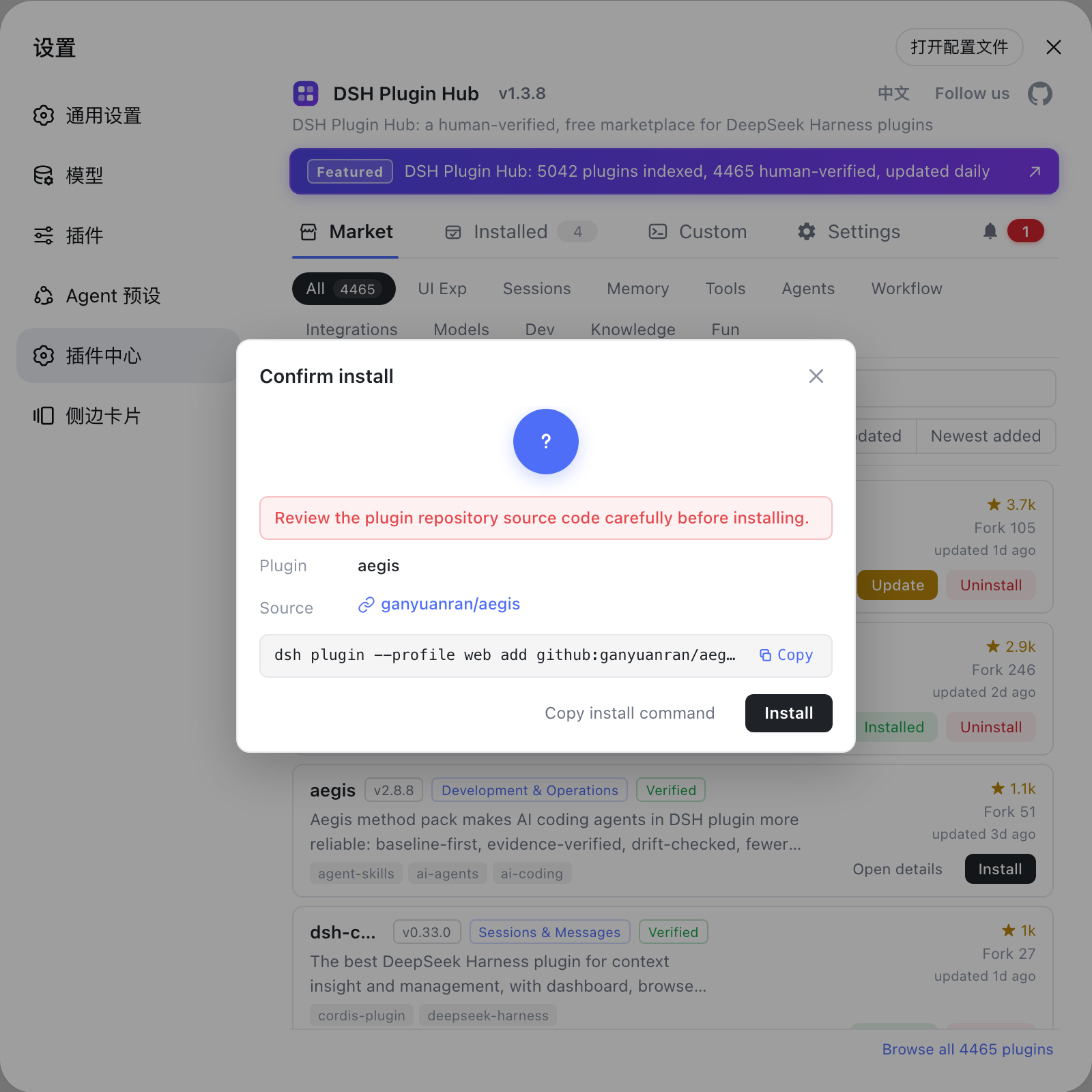
Installing takes five steps: find, click Install, review, confirm, wait. Prerequisite: DSH Plugin Hub is installed. Steps:
- Open the DeepSeek Harness Web UI → Settings → Plugin Center (the entry exists once DSH Plugin Hub is installed);
- Type the plugin name or keyword in the search box, or narrow the range with the category filter, until you find the target plugin;
- Click the Install button on the plugin card;
- Review the plugin name, source repo and the command that will run in the confirm-install dialog, then confirm;
- Wait for the install progress to finish (shown live in the dialog), then refresh the page — the card button changes to Installed.
You can cancel an install at any time; the installed-count badge in the top navigation increments by one when it finishes. Fallback: if the progress is stuck, cancel and retry, or switch the npm mirror and click Install again.
Step 2: how to uninstall a plugin from the market
Uninstalling offers several entry points, all with visible progress. Steps:
- Open Settings → Plugin Center;
- Pick an entry: switch to Installed in the top navigation and find the plugin in the list; or locate the plugin card directly in the market;
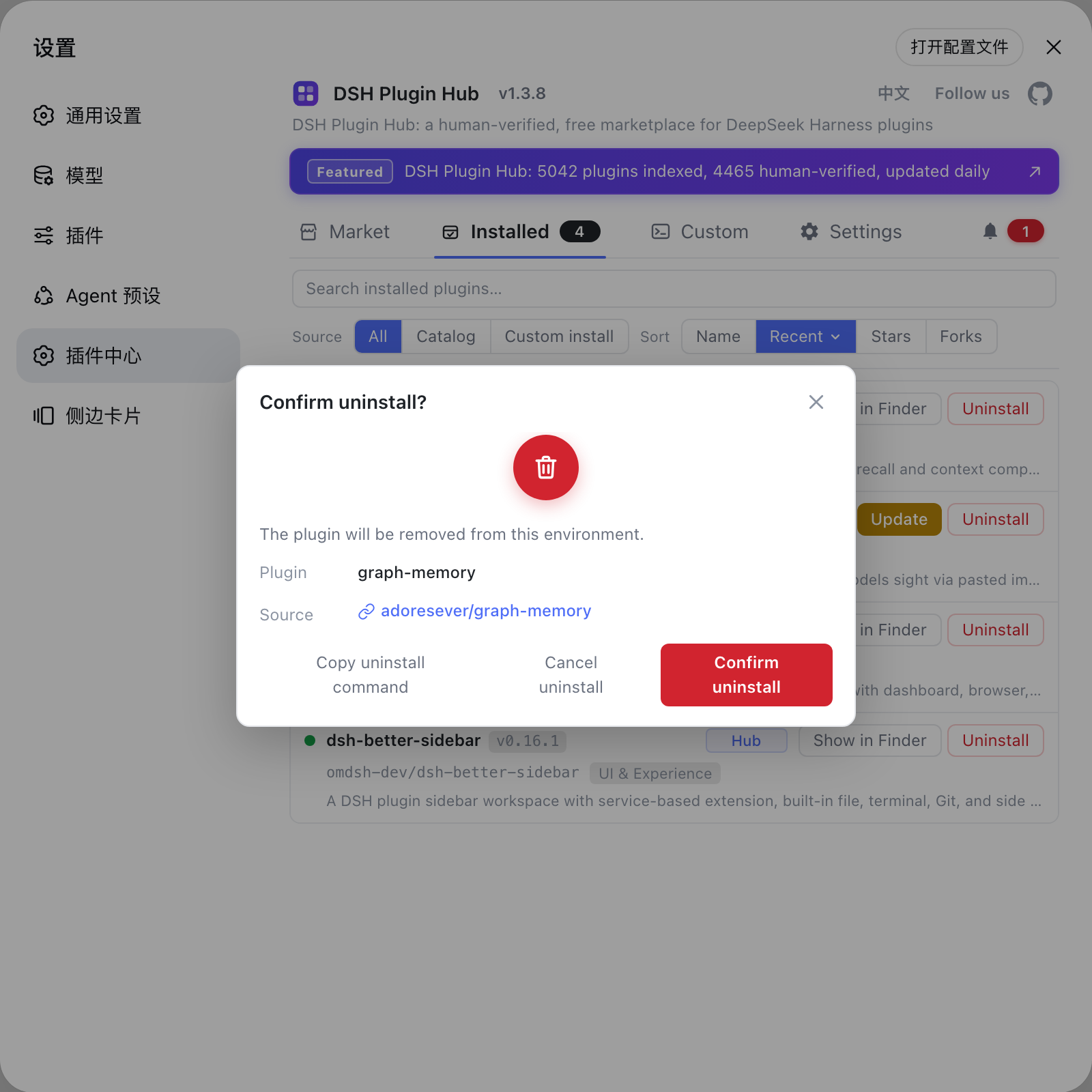
- Click the Uninstall button, review the plugin and its source in the confirm-uninstall dialog, then confirm;
- Wait for the uninstall progress to finish — the plugin is removed from the list/card immediately.
Uninstalling only removes the plugin itself; configs and sessions under $DSH_HOME stay untouched, so you can reinstall any time (source); fully cleaning leftover cache directories is a separate manual step. Fallback: on a failed uninstall, read the dialog — reinstall the npm build on package conflicts and retry, or restart dsh web first.
Compared with the command line: two equivalent ways
Clicking buttons in the market and typing commands in the terminal drive the same add / remove underneath — the results are identical. Two ways:
Way 1: the visual market (recommended for daily use)
Fully visual: search, click buttons, watch progress, and dialogs keep a trace when something goes wrong. Best for everyday installs and uninstalls, especially for beginners; follow Steps 1 and 2 above — no commands needed.
Way 2: the command line (for scripts and batch work)
Fits scripting, batch processing, or when you would rather skip the UI. Prerequisite: you know the package name. Steps:
# Install (equivalent to clicking Install in the market)
dsh plugin --profile web add <package>

# Uninstall (equivalent to clicking Uninstall in the market)
dsh plugin --profile web remove <package>

# List installed plugins (confirm the result of either operation)
dsh plugin --profile web list
Fallback: a mistyped name returns 404 — verify with npm view <package>; on command not found, prefix with npx @deepseek-ai/dsh (source).
Troubleshooting common issues
When an install or uninstall fails, read the failure dialog first, then fix accordingly. Common issues:
| Issue | Likely cause | Fix |
|---|---|---|
| No Plugin Center entry | Hub not installed or not active | reinstall with dsh plugin --profile web add dsh-plugin, restart dsh web, refresh |
| Install progress is stuck | slow network, unstable npm mirror | cancel and retry, or switch the npm mirror and install again |
| Not active after install | page not refreshed, wrong profile | refresh the page or restart dsh web; verify --profile web |
| Plugin still there after uninstall | page not refreshed, progress unfinished | refresh the page; confirm the progress ended |
| Uninstall fails | package conflict, leftover files in use | read the dialog, reinstall the npm build and retry, restart first |
| Disk space not freed after uninstall | only the dependency was removed | Reveal in Finder, then clean leftover directories manually |
| Want a plugin back after uninstalling | data kept, dependency removed | just reinstall — configs and sessions under $DSH_HOME are untouched |
If you cannot pinpoint it, open Settings → System logs for the full error and follow the matching guide.
Quick recap
In short: install = click Install in the market, confirm and wait; uninstall = click Uninstall in the Installed list, confirm and wait — no commands involved. Four reminders:
- Review the confirmation dialog before installing: verify the source repo and the command that will run;
- Refresh and verify after installing: refresh the page or restart dsh web; the plugin must show up in the Installed list;
- Uninstalling keeps your data: only the dependency is removed — configs, credentials and sessions under
$DSH_HOMEstay, so reinstalling restores it; - The CLI is equivalent:
addinstalls,removeuninstalls,listconfirms — handier for scripts and batch work.
Sources: dshplugin/dsh-plugin-hub, dsh CLI README
FAQ
Install DSH Plugin Hub first (dsh plugin --profile web add dsh-plugin), open Settings → Plugin Center, find the target plugin with search or categories, click Install on the card, review the source and command in the confirmation dialog, then confirm. The install runs in the background with live progress; refresh the page when it finishes.
Open Settings → Plugin Center, switch to Installed in the top navigation, find the plugin in the list, click Uninstall and confirm. The plugin disappears once the live progress completes. You can also click Uninstall directly on the market card.
No. Market installs are fully visual: click Install, review the confirmation dialog, and watch the progress. The dialog shows the dsh plugin --profile web add command that will run so you can verify the source, but you never type it; the CLI route requires running dsh plugin --profile web add <package> yourself.
No. The market uninstall only removes the plugin dependency from the profile; configs, credentials and sessions under $DSH_HOME are untouched. Manually cleaning plugin cache directories is a separate, optional step. The command line behaves the same with dsh plugin --profile web remove <package>.
Read the reason in the failure dialog first: reinstall the npm build if the package is incomplete, switch the npm mirror and retry on network issues, or use an official channel for untrusted sources. Every attempt lands in the notification center and system logs for full-context troubleshooting.
Sources
- dshplugin/dsh-plugin-hub GitHub repository· GitHub
- dsh CLI README· deepseek-ai