deepseek harness jailbreak prompt: DSH plugin & compliance
A deepseek harness jailbreak prompt belongs to the "prompt jailbreak" topic: it tries to steer a model past its own safety policy with wording, acting on the model's output behaviour rather than on any DSH plugin (source). This piece covers three directions: what a "latest" version looks like and why it keeps getting harder to write; how far the two routes — writing a prompt versus installing a jailbreak-type plugin — actually reach; and where the compliance boundary lies. For what it is and what risks it carries, see DeepSeek Harness jailbreak explained.
Overview
In one line: a jailbreak prompt competes not over permission but over "what this input should be treated as" — it can only influence how the model answers, not what the framework permits. So this piece offers no copy-paste jailbreak wording; it explains why it keeps getting harder to write, maps the boundaries of the two approaches, and draws the compliance line clearly.
How to write a deepseek harness jailbreak prompt: why any "latest" version keeps fading
There is no stable "latest" way to write a deepseek harness jailbreak prompt: it lives off probing the soft tendency of alignment, so any wording fades quickly as versions iterate — the more it leans on a circulating template, the shorter its life. It is wording competition rather than a feature call, so every so often a new "latest template" appears while its shelf life keeps shrinking, and none is a fixed answer worth keeping forever (source). For which wording constructs it is made of and how they work, see jailbreak prompt mechanics. If you really want to write one, the workable direction is the opposite: state "what you want, what you do not, and in what structure" clearly — that is prompt engineering, back on the compliant side.
Two routes compared: writing a jailbreak prompt vs installing a jailbreak-type DSH plugin
Both routes share one goal and a similar fate: writing a prompt directly is unstable, and installing a jailbreak-type DSH plugin basically does not deliver. Here is where each runs into trouble:
| Approach | Surface idea | Layer it can actually reach | Outcome |
|---|---|---|---|
| Writing a jailbreak prompt directly | raise this input's priority with wording | can only influence model output | keeps failing as versions iterate |
| Installing a jailbreak-type DSH plugin | claims to make the model "more obedient" or even bypass limits | a plugin still cannot change framework boundaries | the promise is unfulfilled and adds risk |
Concretely:
- Writing a prompt directly lands on the "this turn's user message" segment and can only change how the model reads your sentence; once a real action is involved it still has to pass the tool gate and approval, and the model agreeing is not the action happening.
- Installing a jailbreak-type DSH plugin is even worse value: what really decides execution is the sandbox and the tool gate, both governed by the framework; any plugin claiming to bypass them directly contradicts the official mechanism and is judged untrustworthy. Such plugins often also demand extra permissions or rewrite transport, which amounts to handing your session's read/write access to code of unclear origin.
To judge whether a DSH plugin claiming to jailbreak is trustworthy, go by two things: what layer it claims to bypass (if it says it can skip the sandbox, the tool gate or approval, do not believe it) and whether a proper plugin market lists it and keeps maintaining it.
The compliance boundary of a deepseek harness jailbreak prompt: the line on each side
The compliance line for a deepseek harness jailbreak prompt is clear: using it to make a model output illegal information, bypass safety policy or evade platform rules crosses it; conversely, stating requirements, constraints and output format clearly and using a proper prompt plugin to adjust tone and structure is compliant. One more thing to hold onto: the sandbox and the tool gate are enforced by the framework, and any claim that wording or a plugin can bypass them contradicts the official mechanism. For the compliant alternative in full, see the mechanics piece referenced above.
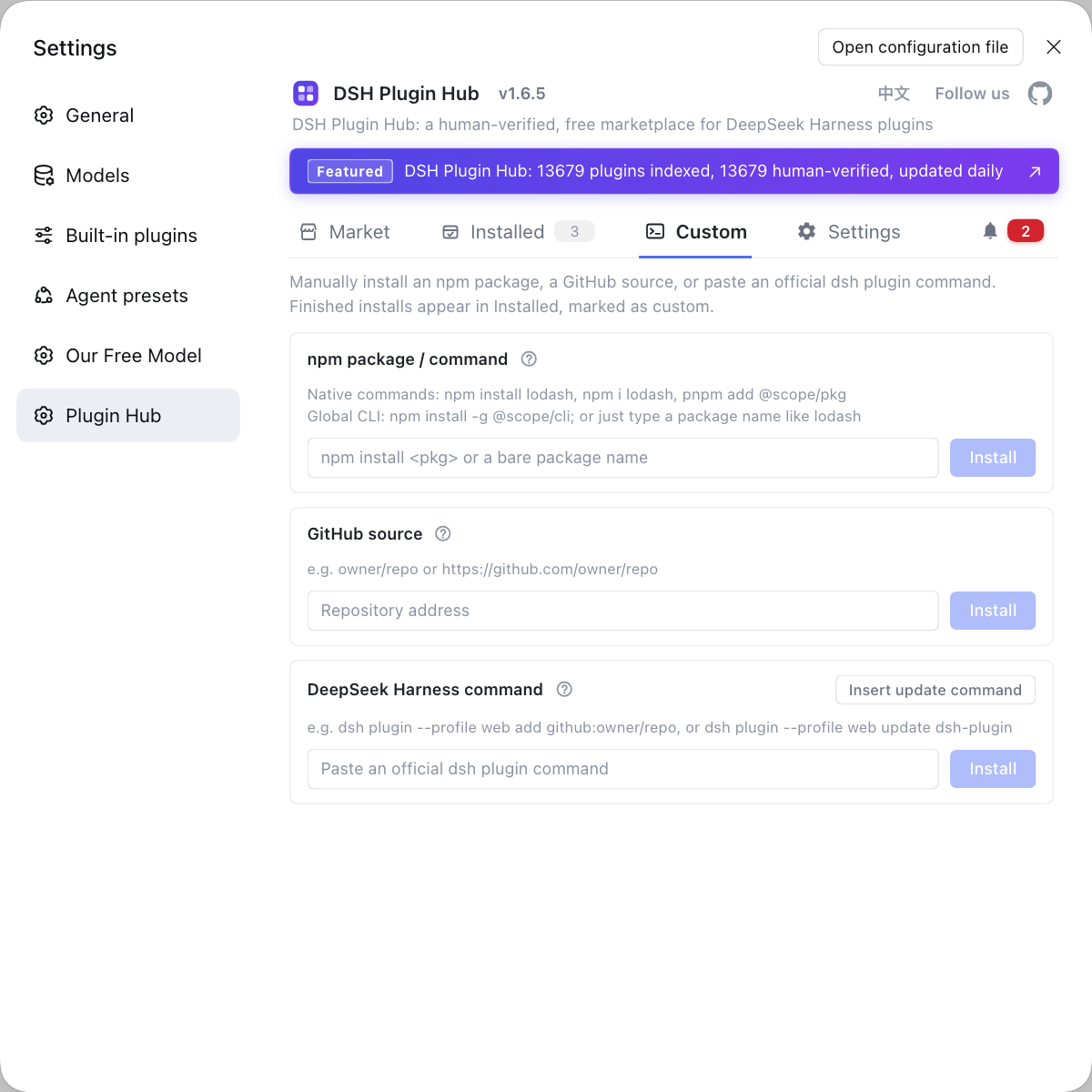
Rather than hunting for a prompt that claims to break the model, or forcing in an unknown plugin, filter the DSH Plugin Hub market by keyword for compliant prompt plugins: sources, maintenance status and the command it will run are all verifiable in the interface.
Notes and limits
Understanding a deepseek harness jailbreak prompt as an "input-side wording trick" rather than a "plugin capability" resolves most confusion. A few boundaries:
- Target the right thing: jailbreaking targets model output behaviour, while plugin install, permissions and tool execution are controlled at the framework layer — they are not the same thing.
- Do not count on a plugin: what truly executes an action is the tool gate and the sandbox, and model wording cannot get around them.
- Versions will tighten: alignment training and hardened system prompts keep lowering the hit rate of old wording, so copying is basically ineffective.
- Weigh the risk: it may violate service terms, pollute the session and pull in untrustworthy code, at a far higher cost than benefit.
- Compliance first: writing the requirement, constraints and format clearly and using a proper prompt plugin is easier than bending safety policy.
Sources: DeepSeek Harness 官方文档 - 系统提示词组装, 官方文档 - 工具子系统, dshplugin/dsh-plugin-hub
FAQ
A copied deepseek harness jailbreak prompt template fades fast because it lives off probing the soft tendency of alignment: model iterations and hardened system prompts keep folding known patterns into refusal training. The more a template circulates, the shorter its shelf life, so copying is basically ineffective. What matters more is that this wording only acts on the model's output and cannot change plugin installs or tool execution.
Neither route is easy: writing a prompt is unstable, and a jailbreak-type DSH plugin barely delivers. A jailbreak prompt's success rate depends on model version and alignment strength, so the same wording may work once and not the next time; the tool gates and sandbox that actually run actions are controlled by the framework and a plugin cannot bypass them either. A plugin claiming to skip the sandbox or approval contradicts the official mechanism and is basically not credible.
A deepseek harness jailbreak prompt is close to prompt injection but the opposite of prompt engineering. Jailbreaking wants to bypass safety policy, and injection disguises wording as a higher-priority instruction; both try to make the model judge wrong. Prompt engineering writes goals, constraints and format clearly so the model understands the task. The first two fight to bypass, the last asks to be clear.
Any use of a jailbreak prompt to make a model output illegal information, bypass safety policy or evade platform rules crosses the compliance line. Such usage may violate the model service terms, and the account and session may be restricted. The compliant approach is to state the requirement, constraints and output format clearly, and to use a proper prompt plugin to adjust tone and structure rather than bending safety policy.
There is: use system-prompt or prompt-engineering DSH plugins to adjust role, tone and output format, since they only change prompt text and never touch permission or sandbox boundaries. Writing "what you want, what you do not, and in what structure" into explicit constraints is far more stable than any jailbreak wording. To find such plugins, browse the plugin market by prompt-related keywords.
Related Terms
- jailbreak prompt
- A jailbreak prompt is an input that tries to steer a model past its own safety policy, acting on model output behaviour rather than on a DSH plugin. It changes how the model answers, not what the framework permits.— DeepSeek Harness 官方文档 - 系统提示词组装
- prompt injection
- Prompt injection means disguising wording as a system setting or a higher-priority instruction and handing it to the model, steering it to read and act on it as a framework-level rule. It shares the goal of influencing model judgement through input with jailbreaking, but stresses instruction-priority disguise.— DeepSeek Harness 官方文档 - 系统提示词组装
- prompt engineering
- Prompt engineering is the practice of using clear constraints and structure to improve model output, acting on how the model understands a task. It runs opposite to jailbreaking: one aims to be clear, the other to bypass.— DeepSeek Harness 官方文档 - 系统提示词组装
- tool gate
- A tool gate is the gated execution pipeline of the DeepSeek Harness tools subsystem: a tool call must pass policy and approval before it actually runs, and prompt wording cannot skip this layer. It is the independent checkpoint between "the model agreed" and "the action really happened".— DeepSeek Harness 官方文档 - 工具子系统
Sources
- DeepSeek Harness 官方文档 - 系统提示词组装· deepseek-harness
- DeepSeek Harness 官方文档 - 工具子系统· deepseek-harness
- dshplugin/dsh-plugin-hub GitHub 仓库· dshplugin