billion-context: DeepSeek Harness long-context DSH plugin
billion-context is a long-context DSH plugin option for DeepSeek Harness: when a single session cannot hold a large repository or a long document, it uses model-driven compaction to fit more information in (source). The "billion" in the name is branding, not a literal token count. This guide covers what problem it targets, how it works, and what risks come with it.
What billion-context solves: one DeepSeek Harness session runs out of room
billion-context targets a concrete pain point: a DeepSeek Harness session has an upper bound, so it cannot read a large repository or a long document in one pass. A session assembles the system prompt, history messages, tool results, and projected content into the input the model truly reads (source), and once the material exceeds capacity it is either compacted or simply does not get in. The symptoms you usually see:
- A large repo does not fit — you want an agent to read a multi-module repository, but halfway through, history starts being compacted. Expected: either it reads shallowly, or the front and back contradict each other.
- A long document will not hold — drop in a manual or a long spec, and a few turns later it "forgets" the start. Expected: answers contradict earlier ones.
- Information drains over long tasks — late in a long task, early decisions were compacted away and the agent starts redoing work. Expected: progress goes in circles.
The billion-context approach is not "make the window infinitely large" but swap in a smarter form of compaction, spending a limited budget on the information that most deserves to stay.
How the billion-context DSH plugin works: model-driven compaction
billion-context builds on the DeepSeek Harness session and compaction mechanism, handing the decision of when and what to compact to the model. DeepSeek Harness ships context compaction that reduces long history to key points; billion-context is an enhancement of that mechanism, not a separate session system. Its working model reads like this:
- Detect long-input pressure — it steps in when a session nears its cap or the material is clearly oversized. Expected: nearly invisible in short conversations.
- The model picks compaction points — the model judges which content to compact and which to keep verbatim, rather than a fixed rule cutting everything the same way. Expected: critical context survives better than with mechanical truncation.
- Keep originals on demand — content that must be reproduced exactly stays readable rather than being crammed into the live context. Expected: immediate tokens are saved without losing detail.
- Evolve continuously — the compaction strategy is re-evaluated as the conversation advances. Expected: stability even in the later half of a long task.
Installation follows the standard DSH plugin flow, with the same command shape as other plugins:
dsh plugin --profile web add billion-context-dsh
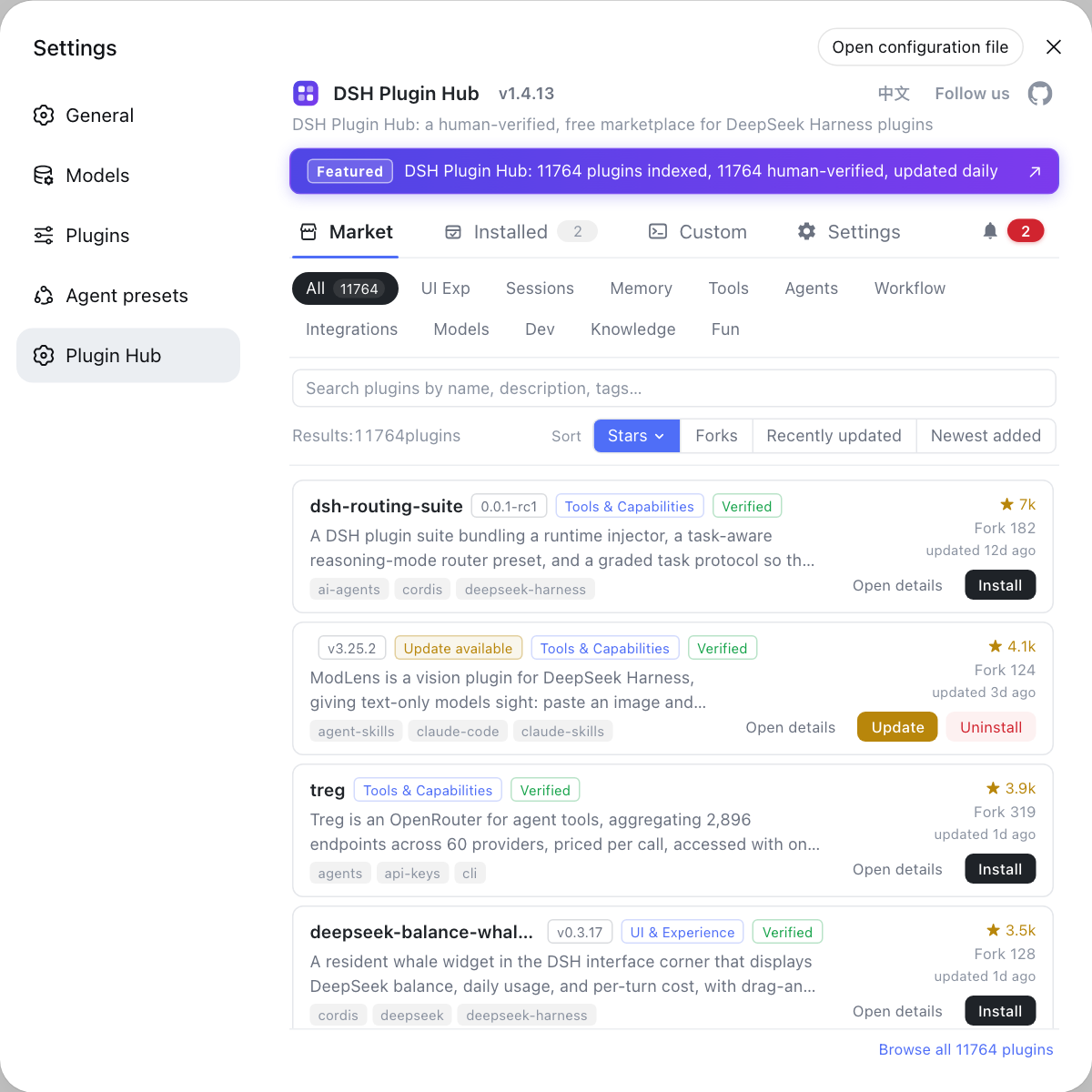
You can also search billion-context on DSH Plugin Hub to find the entry and install it with the command it gives (an npm package name or a github:owner/repo source) in one click.
Who billion-context suits in DeepSeek Harness, and its risks
billion-context suits people who routinely handle large input, but compaction is lossy, so saved tokens and retained detail must be balanced. Three dimensions to judge by:
- Do you need to save tokens — the payoff is clearest when long sessions are expensive and history keeps getting compacted. Expected: lower token footprint per task.
- Will you lose information — compaction always loses detail, and harder compaction loses more. Expected: confirm critical passages survive with a visualization.
- Pair it with a visualization plugin — first use dsh-context for context visualization to see composition before compaction, then judge whether the compaction is reasonable. Expected: the effect is verifiable rather than felt.
In one sentence: it solves a capacity problem, not a comprehension problem. No matter how clever the compaction, it will not make the model magically understand your needs better.
Notes when using a DSH plugin for very long context
- Do not read "billion" literally: it is branding, and the real capacity is still bounded by the model and framework.
- Look before you compact: use a visualization to find the bottleneck first, so you do not add plugins blindly.
- Compaction is lossy: keep important constraints, interface signatures, and acceptance criteria where they are least likely to be compacted.
- Align versions: confirm your DeepSeek Harness version meets the plugin's minimum supported line; too old a build may not take effect.
- Do not stack similar plugins: several long-context or compaction plugins at once may fight each other; get one working smoothly first.
- Combine with a memory plugin: to "remember" across sessions you still need a memory DSH plugin, since compaction only covers one session.
Sources: billion-context-dsh (DSH Plugin Hub), session subsystem (DeepSeek Harness docs).
FAQ
billion-context is a long-context DSH plugin option for DeepSeek Harness, and 'billion' in the name is branding rather than a literal token count. What it actually solves is the engineering problem that a single session cannot hold a large repository or a long document, by using model-driven compaction to expand how much information is manageable. Reading it as "a more capable compaction strategy for long input" is more accurate than reading it as "it truly holds a billion tokens".
billion-context is a compaction enhancement layered on top of the DeepSeek Harness session mechanism; it does not replace the session log but swaps in a different way of deciding when and what to compact. DeepSeek Harness assembles history messages, tool results, and projected content into the model input, and compaction reduces long history to key points. billion-context hands the decision about timing and content to the model, strengthening the framework mechanism rather than standing up a separate session system.
billion-context lowers the token footprint of long sessions through smarter compaction, but it does not guarantee critical information is never lost. Compaction is inherently lossy: saved tokens and retained detail trade off against each other, and harder compaction loses more context. The safe pattern is to pair it with a context-visualization DSH plugin so you can inspect composition before and after compaction and confirm the essential passages survived.
billion-context expands how much context fits, while dsh-context shows what has already been loaded; their goals are opposite and they complement each other rather than being either/or. Use dsh-context first to locate which section is bloating, then use a compaction option such as billion-context to handle long input, so the effect is easier to verify. Which one you install depends on your problem: not enough capacity, or not enough visibility.
When billion-context seems to do nothing, first confirm it went into the profile you are using and that your DeepSeek Harness version meets the minimum supported line. Then check whether it actually intervened in compaction: some plugins only take effect under long-context pressure, so short conversations show no difference. Finally, compare composition before and after compaction with a visualization tool, which is more reliable than judging by feel.
Related Terms
- billion-context
- A long-context DSH plugin option for DeepSeek Harness that expands how much information a single session can hold through model-driven context compaction. 'Billion' in the name is branding and does not mean a literal token count.— DSH Plugin Hub - billion-context-dsh
- context compaction
- The DeepSeek Harness mechanism that reduces long history into key points to control the size of model input. Compaction is lossy, trading saved tokens against retained detail.— DeepSeek Harness docs - session subsystem
- ACP
- The model-driven compaction approach used by the billion-context family, in which the model decides when to compact and what to compact. Moving that decision from fixed rules to model judgment is the core differentiator of this option.— DSH Plugin Hub - billion-context-dsh
- session
- The basic unit in which DeepSeek Harness organizes one conversation's context, assembling system prompt, history messages, tool results, and projected content into the input the model truly reads. Long-context options all act at the session layer.— DeepSeek Harness docs - session subsystem
Sources
- billion-context-dsh (DSH Plugin Hub entry)· dsh-plugin.org
- DeepSeek Harness docs - session subsystem· deepseek-harness