How to choose a DeepSeek Harness memory DSH plugin
Memory plugins for DeepSeek Harness are not "install one and you are done"—classify first, then choose: graph plugins (graph-memory, mnemon) emphasize accurate recall, auditable ones (dsh-memento, dsh-mnemon) emphasize controllable recall, and auto/evolving ones (dsh-auto-memory, dsh-memory-evolve, dsh-meow-memory) emphasize durability with little upkeep. This guide is a multi-plugin comparison and selection guide across three directions: how the three families split, how the three needs map, and how they pair with context plugins.
Overview: three DeepSeek Harness memory plugin families, three needs
One line to choose: for accuracy pick a graph plugin, for control pick an auditable one, for peace of mind pick an auto/evolving one. The comparison:
| Family | Representative plugins | Organization | Fits the need |
|---|---|---|---|
| Structured graph memory | graph-memory, mnemon | typed nodes and edges, graph recall | accurate, source traceable |
| Distillation and audit | dsh-memento, dsh-mnemon | layered distillation, approval gating | controllable, auditable writes |
| Auto-extract and self-evolve | dsh-auto-memory, dsh-memory-evolve, dsh-meow-memory | auto extraction and injection, background consolidation | durable, low upkeep |
All three rest on one premise: cross-session memory is not reliable by default and needs a plugin to persist it (source).
How the three DeepSeek Harness memory plugin families differ: graph, distillation, evolution
The difference is not whether they remember, but how they organize, write, and pull memory back.
- Structured graph memory — turns a conversation into typed nodes and edges forming a knowledge graph, recalled via semantic vector search. graph-memory leans on the graph plus context compression; mnemon stresses LLM-supervised persistent memory, graph organization, intent-aware recall, and automatic deduplication (source). Expected: recall returns knowledge, not a whole chat log.
- Distillation and audit — emphasizes controllable writes. dsh-memento makes memory writes bounded and layered and forces approval, leaving a rebuildable audit log (source); dsh-mnemon layers runtime memory, project docs, and memory spaces with on-demand recall, pluggable sources, and in-UI viewing and editing (source). Expected: every memory is traceable and editable.
- Auto-extract and self-evolve — emphasizes low upkeep. dsh-auto-memory does three-layer automatic memory injection; dsh-meow-memory uses seven-layer SQLite storage, BM25 retrieval, and overnight consolidation; dsh-memory-evolve runs five-track cross-session memory with background self-evolution, letting skills grow alongside memory (source). Expected: install and largely forget, as memory accumulates itself.
Matching the three DeepSeek Harness memory needs: accurate, durable, low-maintenance
Translate the need into one sentence and the family surfaces on its own.
- "I need accuracy and a traceable source" → a graph plugin. Expected: recalled items carry sources and relations, not a vague paragraph.
- "I need long-term accumulation with controllable writes" → an auditable / layered plugin. Expected: key decisions are kept, sensitive writes pass approval, and everything is viewable and editable.
- "I need full automation with almost no upkeep" → an auto/evolving plugin. Expected: daily conversation is distilled automatically, with no manual tidying.
Two practical tips:
- Keep one primary memory plugin: memory features overlap heavily, and installing several often injects duplicates and interferes; get one working before adding more.
- Check the install method:
dsh-mnemon,dsh-meow-memory, anddsh-auto-memoryhave one-step npm paths, whilemnemon,dsh-memory-evolve, andgraph-memoryare usually installed from GitHub, which can hit missing build artifacts or an auth gate.
Working with DeepSeek Harness context plugins
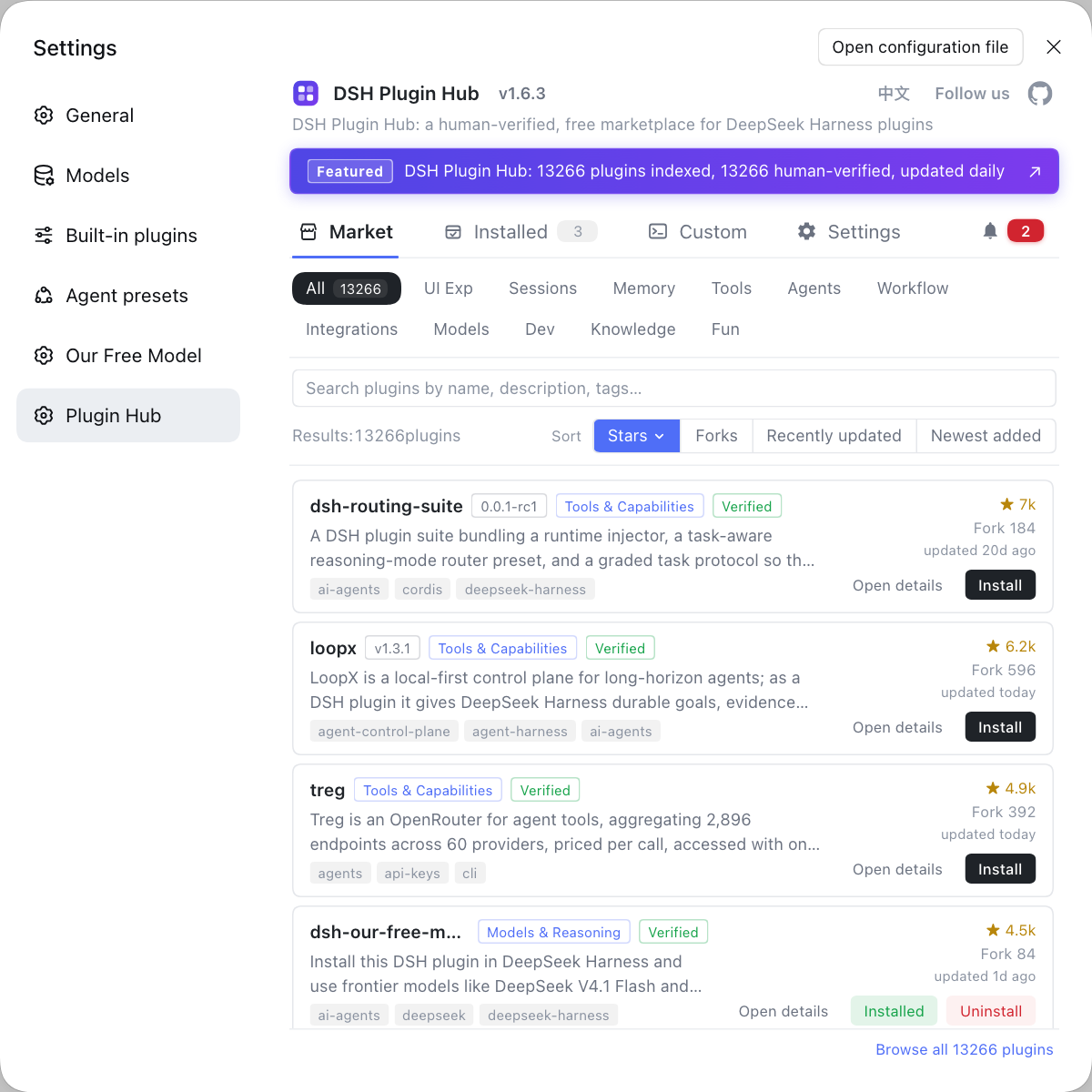
Memory plugins manage the cross-session past; context plugins manage this session's window. The former persists conclusions from old sessions and injects them on demand, the latter visualizes and compresses the current context so the window does not overflow—different jobs that together make a complete setup. To compare more implementations, browse the memory category in DSH Plugin Hub by stars and compatibility status.
Notes on choosing a DeepSeek Harness memory plugin
- Pick the tier before the plugin: choosing by name alone easily goes wrong; sort the need into accurate / durable / auditable first.
- Do not over-install: multiple memory plugins often inject duplicates, so keep one primary.
- Check compatibility status: prefer entries marked verified and trial the unconfirmed ones at small scale.
- Clean up data separately: memory lives in local SQLite or files, and uninstalling the plugin may not delete what was already written.
- Watch where sensitive content is stored: memory persists conversations, so confirm the storage location and approval mechanism when privacy is involved.
Sources: DeepSeek Harness Docs - Session subsystem, mnemon-dev/mnemon, omdsh-dev/dsh-mnemon, csyangwen/dsh-memory-evolve
FAQ
Start by locating the need in one of three tiers—accurate, durable, or auditable—then look at the implementation family, and only then at the install method. For traceable recall pick a graph family plugin (graph-memory, mnemon); for long-lived memory you can control pick an auditable one (dsh-memento, dsh-mnemon); for hands-off automation pick an auto-extracting, evolving one (dsh-auto-memory, dsh-memory-evolve).
They share the structured graph-memory route but differ in emphasis: graph-memory turns a conversation into typed nodes and edges forming a knowledge graph, leaning on semantic vector retrieval and context compression; mnemon stresses LLM-supervised persistent memory organized as a graph, with intent-aware recall and automatic deduplication. Both are mostly local and recall history across sessions instead of replaying whole conversations.
Prefer an implementation with approval gating and an audit log, such as dsh-memento. It makes memory writes bounded and layered and forces them through approval, leaving a rebuildable audit trail; dsh-mnemon instead layers runtime memory, project docs, and memory spaces with on-demand recall, pluggable sources, and a UI to view and edit. Both suit high-control scenarios.
Look at whether it keeps tidying and evolving: dsh-meow-memory uses seven-layer SQLite storage with BM25 retrieval and an overnight consolidation pass; dsh-memory-evolve runs five-track cross-session memory with background self-evolution, and even lets skills grow alongside memory. Choose this tier when you want long-term accumulation without frequent manual upkeep.
They can work together, but avoid installing several memory plugins at once and injecting duplicates. Memory plugins persist history and inject it into new sessions, while context plugins visualize and compress the current window—different jobs; keep one primary memory plugin and let context plugins fill the rest.
Related Terms
- memory provider
- A memory provider is the plugin role that gives DeepSeek Harness memory read/write capability, persisting what happens in a conversation and recalling it on demand in new sessions; implementations differ in storage and retrieval but all sit under this role.— https://github.com/omdsh-dev/dsh-mnemon
- knowledge graph
- A knowledge graph is one way a memory plugin organizes data: facts from a conversation become typed nodes and edges forming a searchable graph, enabling cross-session recall and context compression instead of replaying whole conversations.— https://github.com/adoresever/graph-memory
- session distillation
- Session distillation is the practice of distilling key decisions and conclusions from a session and keeping them long term, common in memory plugins with approval and audit so writes are controllable beforehand and traceable afterward.— https://github.com/PerryLink/dsh-memento
- self-evolve
- Self-evolve is a memory plugin's ability to keep consolidating, merging, and upgrading existing memories and even skills in the background, exemplified by dsh-memory-evolve's five-track memory and skill evolution.— https://github.com/csyangwen/dsh-memory-evolve
Sources
- DeepSeek Harness Docs - Session subsystem· deepseek-harness
- mnemon-dev/mnemon· mnemon-dev
- omdsh-dev/dsh-mnemon· omdsh-dev
- csyangwen/dsh-memory-evolve· csyangwen